

Modelling
Regulation of mRNA and protein dynamics in Mycoplasma pneumoniae.
People involved: Marie Trussart
Transcriptome-wide studies have been wide-spread and highly effective in eukaryotes for more than a decade. However the transcriptomes of bacteria and archaea have been largely overlooked until recently.
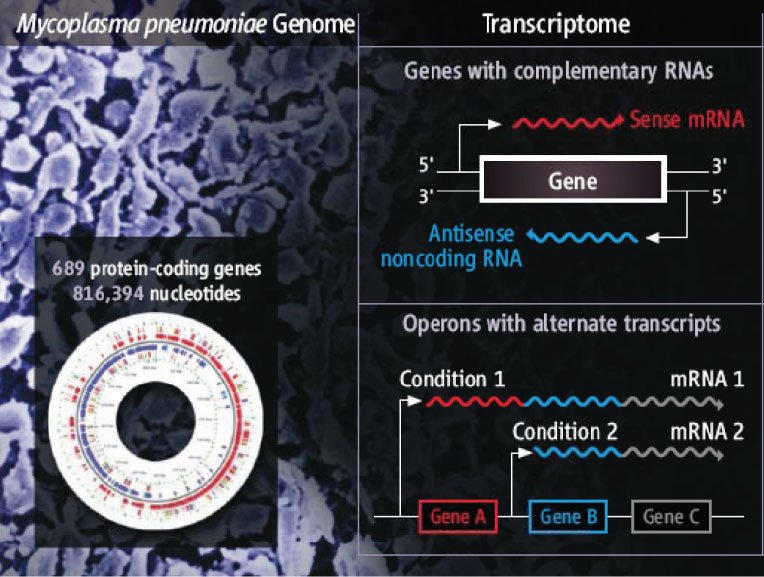 A recent study, involving a genome-reduced bacterium, Mycoplasma pneumoniae, the smallest selfreplicating organism known to date, has revealed impressive transcriptome complexity. An unexpected abundance of antisense transcription and alternative transcripts within operons suggests a highly structured multifaceted regulatory machinery. Yet, this organism has few transcription factors encoded in its genome, suggesting an additional layer of regulation. Studies focused on RNA processing and half-life determination will help us immensely in understanding the complex transcriptional regulation of prokaryotes.
We seek to build a detailed model of transcription in Mycoplasma pneumoniae, integrating gene expression whose dynamics depend on multiple regulators. We have a transcriptomics dataset consisting of more than 300 experiments which provide mRNA levels for all genes across different conditions. These data can be used to estimate the parameters required for the model.
Modeling M. pneumoniae metabolism
People involved: Judith Wodke
By combining different modeling approaches this project aims at integrating the wealth of data available on M. pneumoniae metabolism into one big picture, thereby gaining insight into the metabolic network structure and the underlying regulatory mechanism. Besides, unexpected functions can be revealed and useful experiments can be suggested by in silico simulation and mathematically analyses of the metabolic network of M. pneumoniae.